Architecture Design of Slips Immune
Introduction
The new Slips architecture takes inspiration from the field of immunology to (i) better detect attacks, (ii) better avoid false positives, (iii) better decide when to react to an attack, and in general to (iv) improve its capabilities as an intrusion detection system.
This document describes the main aspects of the new Slips architecture, how each part interacts with the others, and why. Future documents will describe (i) the details of the human immune system, (ii) the reasons why Slips uses immunology concepts, (iii) the similarities and differences between the real human immune system and other artificial immune proposals, and (iv) additional immunology concepts not implemented in this version of Slips.
Quick terminology agreement
Since there are many terms and acronyms used in the field, we will use human in front of any concept from biology (e.g., human immune system). If we do not use it, such as in adaptive system, then we refer to the version implemented in Slips. This avoids having to use words like artificial and others repeatedly.
Immunology principles used in Slips
For this version of Slips we chose to implement only some of the human immune system concepts, as described in the following sections. For each main concept, we provide a brief biological description and explain how it was translated into Slips.
This is a summary of the design changes to the current Slips architecture to incorporate immunology concepts:
Clear separation of the innate system for generic fast detection, and the adaptive system for slower-to-activate but very precise and powerful detection.
Use of two-pathway activation of the adaptive system to reduce false positives.
Use, in the innate system, of PAMP-type signals as the first pathway for activating the adaptive system. This corresponds to detectors of generic malicious attacks and TTPs of malicious actors (based on standard immunology theory).
Use, in the innate system, of DAMP-type signals as the second pathway for activating the adaptive system. This corresponds to stress or danger signals detected by anomaly detection in the P2P system (based on the danger theory of immunology).
Creation, in the adaptive system, of semi-random precise detectors, using negative selection and genetic-based adaptation.
Implementation, in the adaptive system, of memorization for activated and successful detectors, allowing them to be reused very quickly in the future.
Implementation of mechanisms to stop threats in two modalities: firewall blocks and ARP poisoning attacks in the local network.
Implementation of communication signals on top of the current P2P communication network, including DAMP and PAMP signals.
General Diagram of Slips Immune Architecture
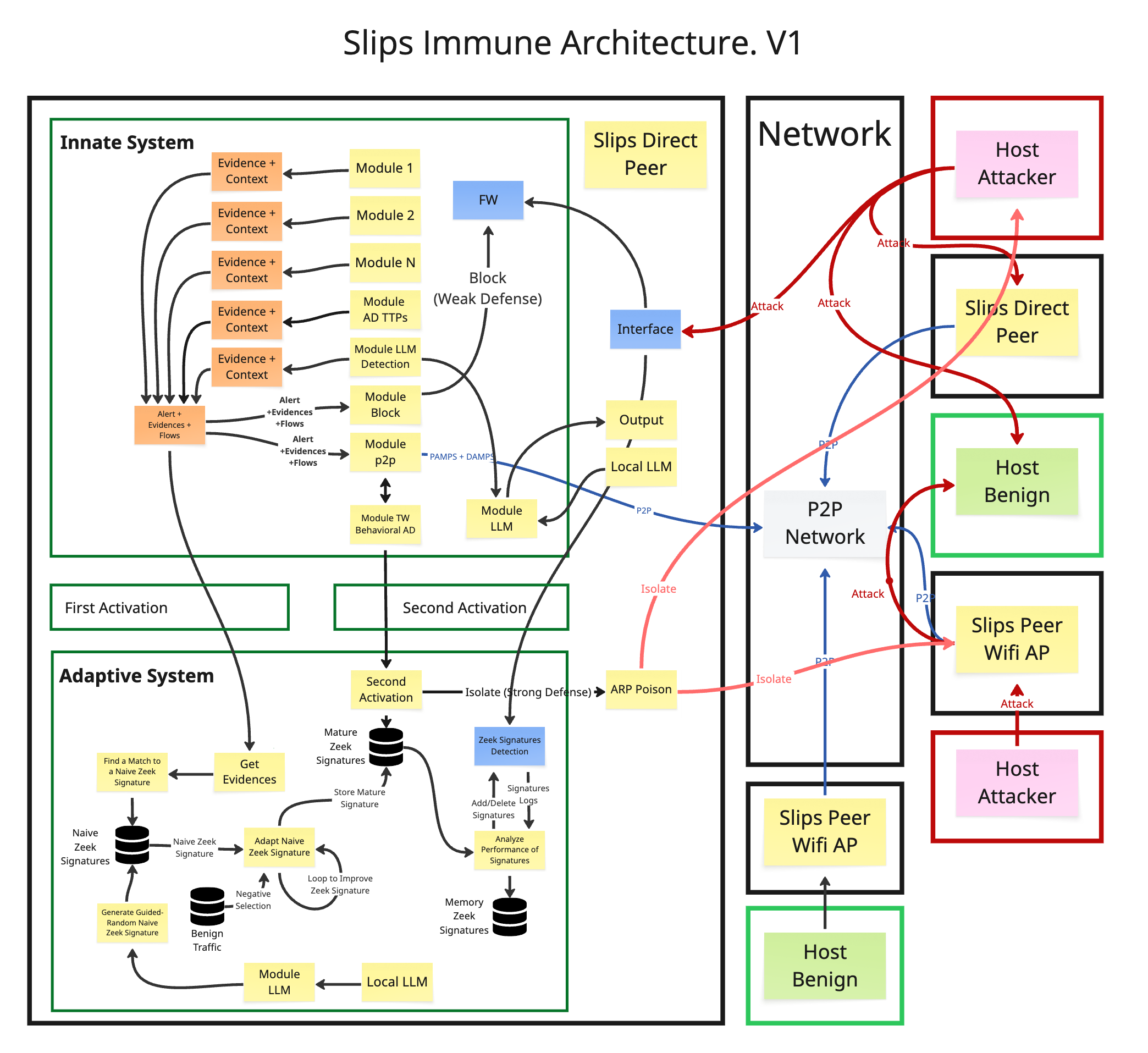
From Immunology to Cybersecurity
The human immune system is an evolved, vast, complex, and not fully understood network of millions of interacting parts that produce emergent behaviours to protect humans and help the species survive.
The first proposal to apply immunology concepts to cybersecurity appeared in the 1987 paper Computer Viruses, Theory and Practice, which described malicious software as a “virus” [1]. In the 1980s and 1990s, many papers, software projects, and companies proposed, implemented, and described a “computer immune system,” “cybersecurity immune system,” or even an “Internet immune system.” These proposals explored different ways to protect computers by attempting to learn from the human immune system.
However, although many papers exist in the area, most only adopt a very simple and limited part of immunology ideas—or merely call their technique “immunology” because they use anomaly detection algorithms. We do not consider any of these proposals to be a real, complete, or valid transcription and implementation of immunology concepts into cybersecurity. To the best of our knowledge, as of 2025, there is no software that can be downloaded, run, or purchased that truly uses immunology concepts and not just anomaly detection.
Our own ideas of how immunology can be used as an analogy for computer security are at best simplistic, and at worst completely wrong.
First Concept: Innate and Adaptive Systems in Slips
In Slips, the innate and adaptive systems are implemented through a separation of functions inside the modules and capabilities of Slips. Slips tries to resemble a single cell in its operation, but current network communication and operation technologies are not strong enough in most networks to support multiple Slips instances playing different cell roles. For now, therefore, Slips will also play the role of different immune cells inside a single host.
Innate System
The human innate system is composed of a large group of cells and activities, but in principle it is able to:
React very quickly.
Detect generic traits of pathogens based on the detection of specific Pathogen-Associated Molecular Patterns (PAMPs).
Regulate and sense Damage-Associated Molecular Patterns (DAMPs).
The non-self detection theory of the human immune system says that there is no such thing as detecting the concept of self in cells. The only concept of self is trained during weak matching in the training of new T-cells and B-cells, to ensure they only receive pathogen parts from MHC Class II molecules. Apart from this, the human immune system does not have a concept of self. What it has is a concept of non-self, achieved by explicitly detecting the PAMPs of known pathogens.
Detection of Non-self with PAMPs in Slips
Most of the current modules in Slips version <= 1.1.12 play the role of the innate system. These include: Input, Output, mlflowdetection, arp, cesnet, cyst, ensembling, exporting_alerts, http_analyzer, ip_info, iris_module, leak_detector, network_discovery, p2p_trust, risk_iq, rnn_cc_detection, threat_intelligence, virustotal, and update_manager. Some core parts of Slips are also part of the immune system, such as output.
These modules are part of the innate system because they are very generic (e.g., port scan detector, unknown HTTP User-Agent, etc.), which makes them easy to create and train but also prone to false positives. Therefore, detections like unknown HTTP User-Agent are considered PAMPs by Slips since they are attack-associated patterns.
A new addition to the innate system in Slips will be the module to detect TTP (Tactics, Techniques, and Procedures) signatures. This new module will focus on detecting generic signs of the TTPs used by most internal attackers. In the ‘Diagram of General Slips Architecture. V1’, this module is called Module AD TTPs, because it will also use anomaly detection. It will be pre-trained with known tools and traffic expected during the TTPs of certain APT groups. This module will be trained in a counterintuitive direction compared to most classical detectors: it will be more general and deliberately tolerate false positives. Therefore, some TTPs are also considered PAMPs since they are directly related to attack-associated patterns.
The speed of response required by the innate system is implemented in Slips by directly adding rules to the host computer’s firewall. This is a defensive mechanism, not an attacking mechanism. More about this decision can be read in Section [[#Attacking or Defending]]. We have not found any faster response to a network attack than a firewall rule to stop it.
Detection of Danger Signals with DAMPs
In the human innate system there is also the concept of detecting DAMPs (Damage-Associated Molecular Patterns), which occur when many different cells find signs that something bad has happened. DAMPs can be molecules that induce inflammation, molecules that raise body temperature, or even evidence that a normal cell has died incorrectly.
The critical difference between PAMPs and DAMPs is that PAMPs are patterns of pathogens, while DAMPs are patterns of damage. They are related but not the same, and they do not come from the same source. This difference is key because these signals are the two pathways for activating the adaptive system later, and therefore for reducing false positives. They cannot come from the same source. They reduce false positives because they provide independent evidence of the same phenomenon.
Generating DAMPs in Slips is not an easy task because, when running on a single computer, it is hard to find two related but independent signals that indicate an attack. DAMPs should represent damage, danger, or indirect evidence of something bad happening.
We decided that DAMPs in Slips will be represented in two ways:
By using its P2P network to send signals to other peers.
By computing the behavioural profile of all other hosts in the network and identifying anomalies in their behaviour.
DAMPs as Damage signals in the P2P Network
Each peer in the P2P network is connected to the others and capable of exchanging information. Each peer also computes how much it trusts each of the other peers.
In the current version of Slips, this is already implemented: Slips exchanges alerts with its peers. Slips also defines its own terminology for alerts and evidences. An alert is a signal to block or stop a computer after enough evidence of maliciousness has been observed. An evidence is the output of a specific detector, with a confidence value and numerical threat level. When enough evidence is collected to pass the threshold, an alert is generated for that host. Therefore, Slips currently exchanges alerts (e.g., “block host A”) but not evidences (e.g., “unknown HTTP User-Agent”).
These alerts between peers provide an initial view of what is happening elsewhere in the network and which attacks are being received. This enables faster protection, since peers can defend against attackers that have not yet targeted them, based solely on reports from others.
DAMPs as Anomaly Detection on Behaviours
One of the most innovative additions to Slips will be the analysis of behavioural changes in known hosts across the network, used as a proxy to measure damage and stress.
Slips currently tracks each host it communicates with or receives traffic from, and divides this traffic into time windows. A time window (typically one hour) holds all the summarized flows, communications, services, evidences, and alerts for that host. Each time window for each host contains around 15 features.
The new idea is to use anomaly detection algorithms to track and study the behaviour of all known hosts in order to detect when their behaviour changes.
A change in behaviour is not sufficient on its own to prove that something bad has happened, but it is enough to show that something has changed. The algorithm will be trained with new data so it adapts over time. Training will occur when no alerts are present for that host over several consecutive time windows.
Anomalies in behaviour will be considered DAMPs, since we assume that after an attack a host’s traffic pattern will change.
These behavioural changes may also be sent as a special type of evidence in the P2P network, since each peer only has a partial view of the traffic. Sharing this information with others is particularly valuable.
Trained Immunity
A recently discovered concept in human immunology is trained immunity. It means that even the innate system can be trained. The mechanisms are not yet completely understood, but under certain conditions the innate system appears to develop memory.
In Slips, training of the innate system is currently done in two ways:
By the experts designing Slips when new versions are created and published. These updates are received whenever Slips is upgraded.
By the user, when Slips is run in train mode on their local traffic, which modifies the machine learning module of mlflowdetector. Currently there are no safeguards on this training, but they will be added.
Adaptive Immune System
The human adaptive immune system has many characteristics described, but for the purposes of our work only some of them will be recreated in Slips. In Slips, the adaptive system must be created from scratch.
The parts of the adaptive system implemented in Slips will be:
Creation of guided-random new detectors.
Negative selection.
Two-pathway activation.
Evolution of pattern matching to improve accuracy.
Memory cells of successful detectors.
Slow activation, fast action.
Guided-random new detectors
For the adaptive immune system, Slips implements the creation of many Zeek detection scripts that are guided-randomly adapted (not evolved and not a genetic algorithm) to get very precise fast rule-based detectors with context information.
The negative selection will be done using a local offline database of benign traffic (described later).
The idea of the guided-random creation is to:
Create many guided-random detection scripts for Zeek using the new local LLM module. It is random only for certain parts of the Zeek script.
A basic template of the detector is given
An LLM choses each part of the template according to what it is expected. If it is a URL then a URL, if it is a domain, then a domain.
Positive Selection. Each script should:
Recognize some traffic
Be syntactically correct
Compile and load
Compile
Negative Selection. Each script should:
Be tested against a large DB of benign traffic.
If any match happens the script is discarded.
The following is a more detail diagram of how the innate and adaptive system relate to the new ideas of generating new detectors.
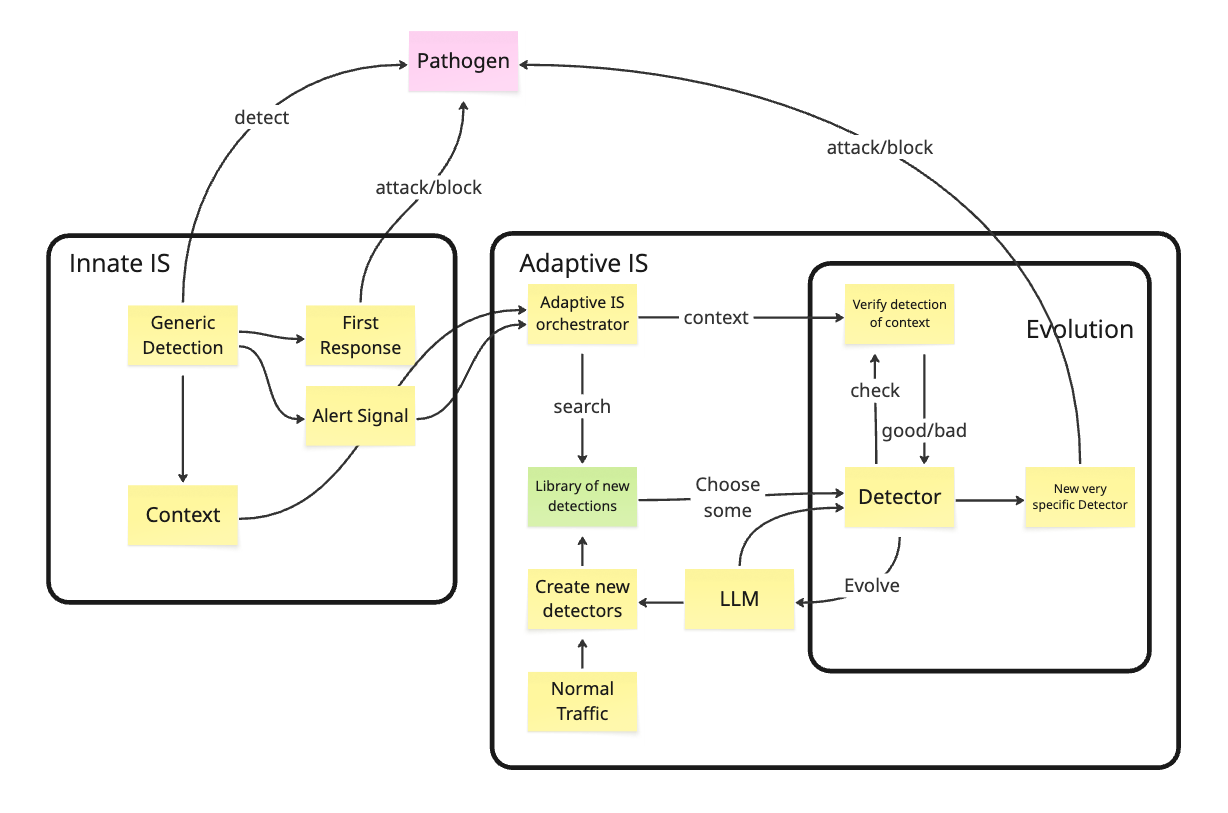
Negative Selection
Negative selection will be carried out as follows:
Obtain a global predefined database of benign traffic. This will be in the form of Zeek text flows. Sometimes it will consist of a single isolated flow, and sometimes an entire time window of traffic.
It is crucial to also include the benign traffic of the local computer. This will be done by waiting for the following conditions:
The user runs Slips in train mode with the label benign.
No alerts are generated in this mode.
Each created Zeek script is run against all of this traffic, and if the script generates a detection, it is discarded.
Each Zeek script will also have a time-to-live value, which will be used to decommission it later as a false positive reduction technique, inspired by the behaviour of the human immune system.
Confirmed Activation, Fast Strong Action
The detectors of the adaptive system must be confirmed before activation because their response is very strong and can have significant consequences. This is achieved through Two Pathway Activation.
For the action to be fast, the detector must be directly injected as a Zeek script into the running Zeek process. These scripts are designed to be very fast, simple, and highly performant. This is handled directly by Zeek.
For the action to be strong, Slips will block and isolate the attacker in the local network using an ARP poisoning attack.
Two Pathway Activation
The two pathway activation works like this
The first activation are the PAMPs detected by the innate system. These are the alerts in Slips, built from most evidences of the current modules in Slips. Slips also may share these PAMPs in the P2P network.
Since Slips has many different working topologies, such as checking its own traffic, checking a computer behind the wifi-mode, checking an external computer in the local network and checking external computers in a WAN, then sometimes there is no concept of receiving a PAMP from other Slips peer.
When a PAMP is received or generated, it is stored.
The reception or generation of a PAMP triggers a simple defensive response, that is to block the IP address of the threat in the local Firewall.
The second activation comes from the DAMPs. DAMPs can be generated by the local Slips or received from the P2P network.
Only when both signals are received then the stronger defense is used and Slips isolates or blocks the attacker using ARP cache poisoning techniques.
Evolution of Pattern Matching Detectors Upon Search
When the adaptive system receives a PAMP detection together with some context flows, it will try to determine whether it has stored Zeek detector scripts that can match the context.
Depending on how the Zeek detectors are created, they may output either the percentage of matches or the confidence level of the detection. These values provide an estimate of how good the match is—essentially a metric of the detector’s goodness of fit.
For example, the URL https://www.test.com might be matched by the regex:
\b(https?://\w+\.\w{2,})\b
However, this regex is too generic and would also match many other URLs. A more restrictive regex such as:
\b(https?:\/\/\w+\.([a-zA-Z]{2,})\.\w{2,})\b
would provide a tighter match to the specific URL.
Another idea to explore is detector complexity: more complex detectors that still match the target string may be considered more restrictive.
If a suitable metric can be defined, it can then serve as the foundation for a simple evolutionary algorithm to improve the Zeek detectors.
The algorithm could work as follows:
When a Zeek detector achieves more than X% match (or only for the best detector):
Ask the LLM module to adapt the detector, given the context, to make it more restrictive and likely to detect only those specific strings.
It is true that the most restrictive detector would be to directly use the context strings and block them, but this may not be the best approach. It is important to note that the original context of an alert cannot be used directly for detection without a Zeek detector that matches it. The context might be wrong or might capture benign patterns. The only reliable way to use the context is by extending a currently verified Zeek detector that has already passed negative selection.
Once the Zeek detector is improved, it is tested again against the context flows. The loop continues until a Zeek detector with a sufficiently high threshold (likely between 95% and 99%) is created.
Interestingly, the human immune system has a small hole in this process: newly created detectors (B-cells or T-cells) are not re-checked against benign “self” patterns after the adaptation. The body lacks the time and resources to do this, leading to many autoimmune diseases. However, in the Slips adaptive system, there may be extra time to run the improved Zeek detector against benign traffic again to confirm it does not produce false positives.
Decommission of Detectors
The performance of each detector will be recorded, especially when feedback from false positives is available.
This performance data, together with the time-to-live value, will be used to decide whether to decommission or retain detectors. If a detector does not perform well enough, it will be deleted after its time-to-live period (measured in days). If it does perform well, see Memory Cells.
Memory Cells
Since the performance of each detector is tracked, well-performing detectors will be stored for faster future use by keeping them in the Zeek detection configuration. For the initial implementation, a fixed threshold will determine what qualifies as a “good” detector.
A potential problem arises if too many good detectors are retained, causing detection speed to degrade. If this happens, Slips will rank detectors by performance and by their most recent detection time. Detectors that continue to generate detections will have higher priority in the database, which will be pruned to maintain a fixed maximum number of remembered detectors.
Anergy
Anergy, in the human immune system, is the elimination of detector cells that were once effective but later began to detect “self.”
In Slips, this will be implemented by tracking the performance of each detector once enough information is received from the human operator about a false positive. When a detector is determined to be sufficiently unreliable, it will either be deactivated or its threshold lowered.
There are many reasons why a good detector may start to fail, the most common being different forms of concept drift.
In a sense, Slips already performs a form of Anergy when its designers detect a false positive and adjust or remove a detector. However, this process is manual and slow.
Immunoregulation
Immunoregulation refers to all the actions taken by the immune system to:
Amplification — Ensure the entire system is aware of the threat so it is not overlooked.
Control the Power of the Response — Avoid overreacting to a threat.
Ensure the Response Is Timely — Act quickly enough to counter the threat.
Slow Down After the Threat Is Gone — Stop actions once the threat has been removed.
In Slips, immunoregulation will be implemented in two ways:
Inside the local Slips host.
Through communication with other peers in the P2P network.
Slips Host
Amplification
There is no need for amplification inside a single Slips host, since the whole system already has the information.
Control Power of Answer
The innate system blocks via the firewall.
The adaptive system blocks via an ARP poisoning attack.
Be Sure the Answer Is on Time
Firewall rules are added to the local firewall for fast response.
Zeek scripts are injected into the Zeek process.
The ARP poisoning attack is executed as soon as it is approved by the adaptive system.
Slowdown After the Threat Is Gone
The slowdown depends on the number of evidences and alerts generated in the current time window.
Currently, Slips implements the following behaviour:
After the attacker is blocked, all new alerts from that attacker are still stored.
When the attacker stops attacking, it enters a probation period of one time window. During this period, the attacker host is expected not to generate any alerts.
If no alerts are generated in that probation period, then in the second time window after the last block, the attacker is unblocked.
If the attacker continues to attack and generate evidences and alerts, it remains blocked.
P2P Network
Amplification
For alerts generated from PAMPs and profile violations (DAMPs):
Every time the local Slips generates an alert, send it into the P2P network.
Every time the local Slips receives an alert in the P2P network from another peer, and that alert originated in that peer, resend it to the P2P network.
(This ensures alerts generated by peer A and sent by peer A are amplified, but ignores alerts that peer A forwards on behalf of peer B.)
Control Power of Answer
The innate system blocks via the firewall.
The adaptive system blocks via an ARP poisoning attack.
Be Sure the Answer Is on Time
Firewall rules are added to the local firewall for fast response.
Zeek scripts are injected into the Zeek process.
The ARP poisoning attack is executed as soon as it is approved by the adaptive system.
Slowdown After the Threat Is Gone
The slowdown of the response depends on the number of PAMPs and DAMPs still received by peers in the network.
When the attack stops, no more evidences are generated by peers and no further alerts should be sent or amplified.
When PAMPs stop, the firewall block and ARP poisoning should also stop. (The firewall only requires PAMPs to be activated, but the ARP poisoning attack requires both PAMPs and DAMPs.)
When the attack stops, the host’s behaviour should also return to normal, which will eventually stop DAMPs. This typically takes more time.
A waiting function, based on the time window, will be applied so these changes do not happen immediately after flows stop being received.
Stopping the Threats
The main goal of the human immune system is to protect us by killing pathogens, neutralising them, or expelling them. Slips needs to do the same in order to be effective.
To stop threats, Slips implements two actions:
Block in the local firewall
When an alert is generated for a host (PAMPs are detected by the innate system only), the host is blocked in the firewall of the local machine.
ARP Cache Poison Attack
When both PAMPs and DAMPs are detected, the attacker host is isolated through an ARP cache poisoning attack.